
'Aligner', Debate, and the Unknowable
More research on weak-to-strong, truthfulness via debate, and more

Aligner: Achieving Efficient Alignment through Weak-to-Strong Correction
‘Aligner’ introduces a new form of Weak-to-Strong in the hopes of automating alignment research.
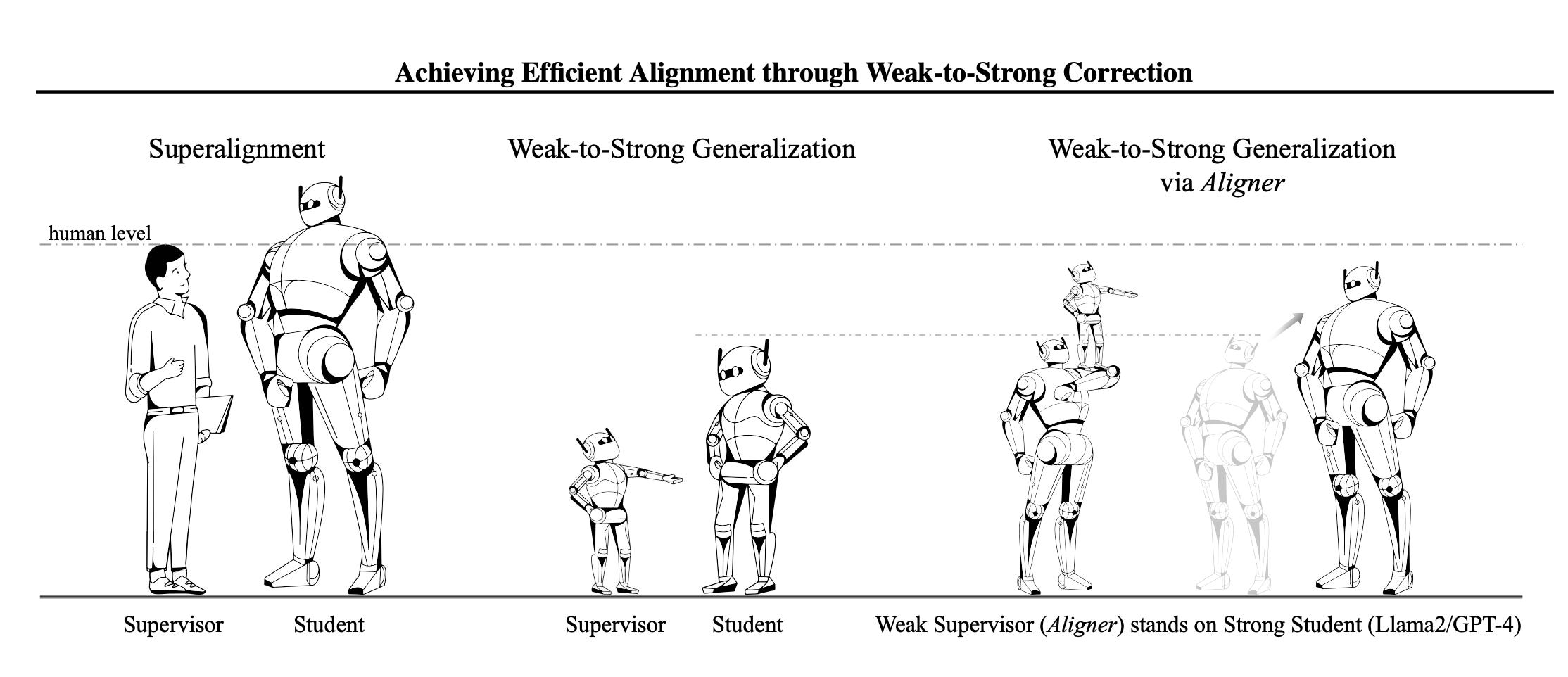
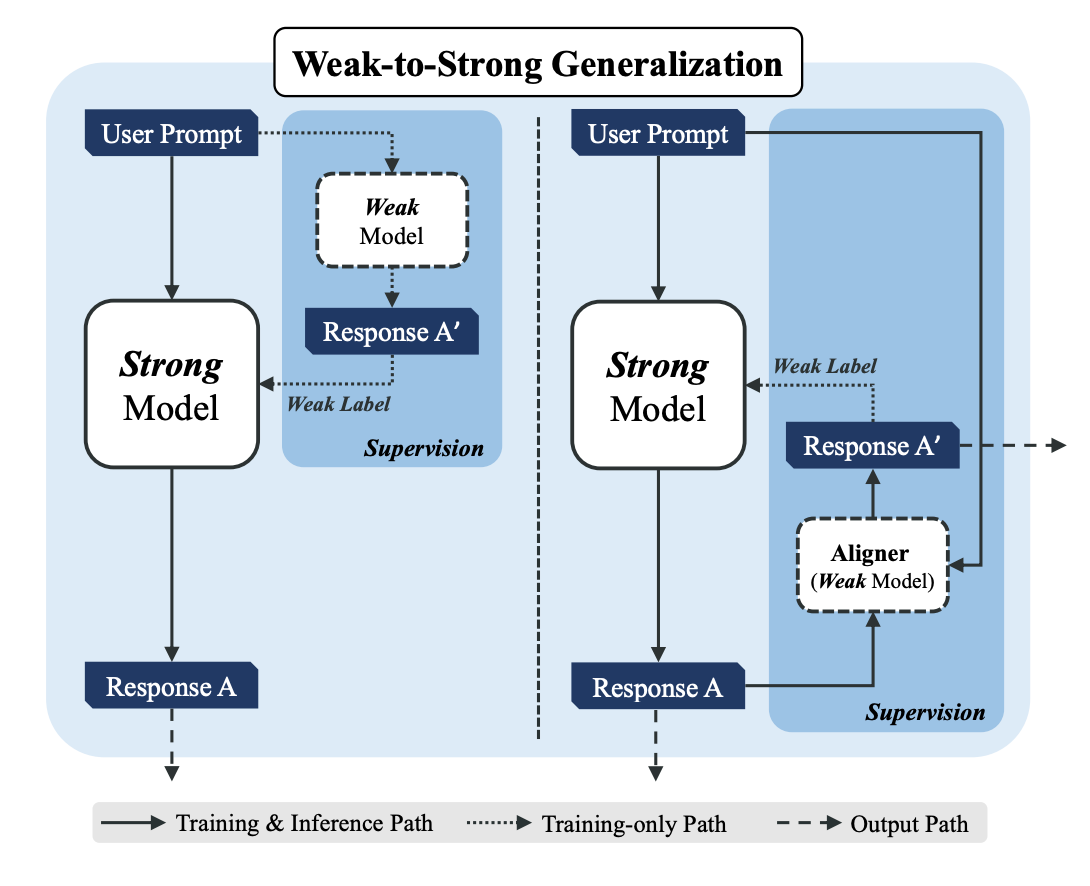
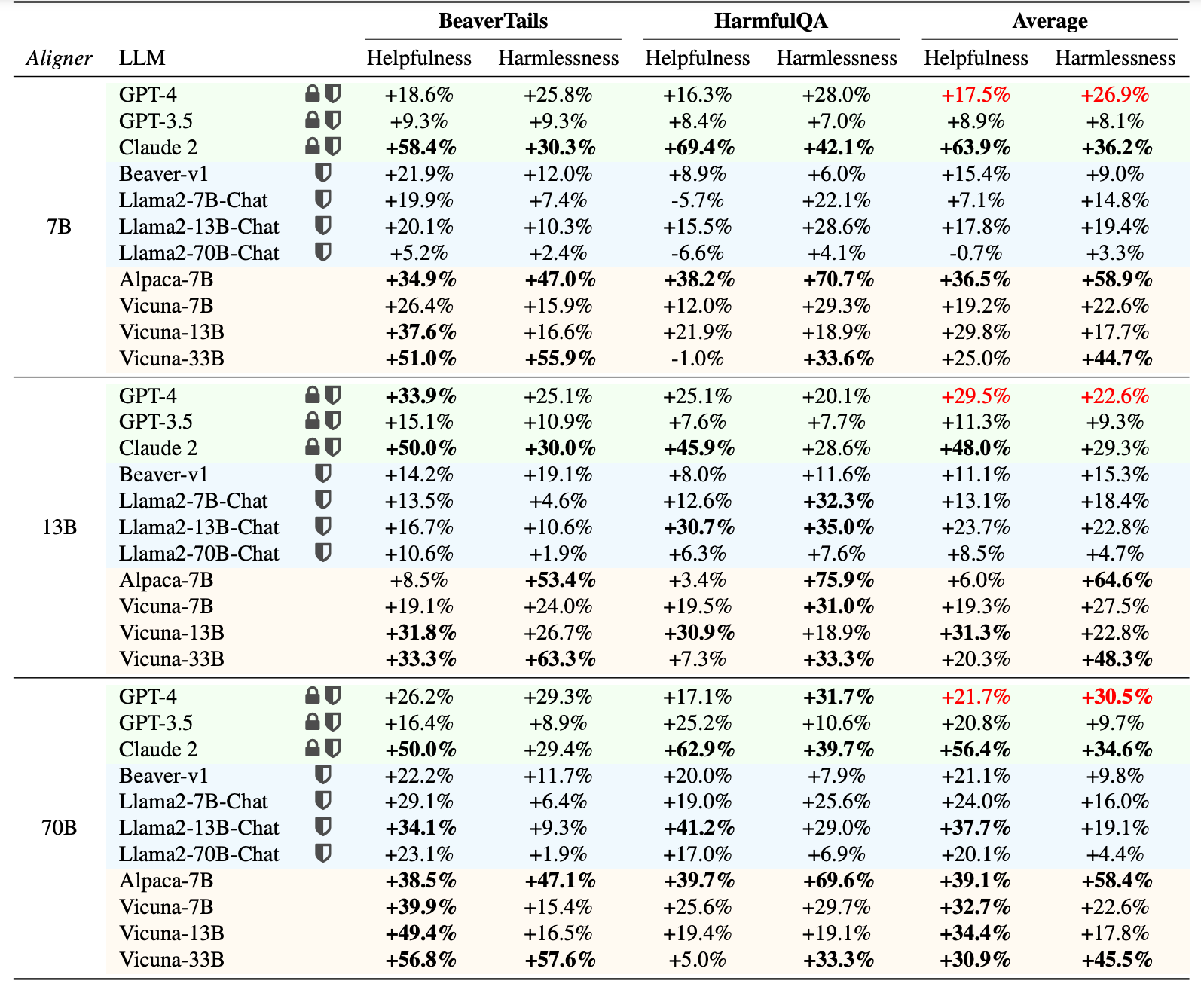
Abstract: Efforts to align Large Language Models (LLMs) are mainly conducted via Reinforcement Learning from Human Feedback (RLHF) methods. However, RLHF encounters major challenges including training reward models, actor-critic engineering, and importantly, it requires access to LLM parameters. Here we introduce Aligner, a new efficient alignment paradigm that bypasses the whole RLHF process by learning the correctional residuals between the aligned and the unaligned answers. Our Aligner offers several key advantages. Firstly, it is an autoregressive seq2seq model that is trained on the query-answer-correction dataset via supervised learning; this offers a parameter-efficient alignment solution with minimal resources. Secondly, the Aligner facilitates weak-to-strong generalization; finetuning large pretrained models by Aligner's supervisory signals demonstrates strong performance boost. Thirdly, Aligner functions as a model-agnostic plug-and-play module, allowing for its direct application on different open-source and API-based models. Remarkably, Aligner-7B improves 11 different LLMs by 21.9% in helpfulness and 23.8% in harmlessness on average (GPT-4 by 17.5% and 26.9%). When finetuning (strong) Llama2-70B with (weak) Aligner-13B's supervision, we can improve Llama2 by 8.2% in helpfulness and 61.6% in harmlessness
.
Summary (GPT4): The article introduces Aligner, an efficient alignment paradigm for Large Language Models (LLMs) that sidesteps the complexities associated with Reinforcement Learning from Human Feedback (RLHF) methods. Aligner operates by learning the correctional differences between aligned and unaligned responses, offering a more resource-efficient way to align LLMs with human values and intentions without needing access to the LLM parameters.
Key highlights include:
Methodology: Aligner is an autoregressive sequence-to-sequence (seq2seq) model trained via supervised learning on a dataset composed of query-answer-correction trios. This method emphasizes parameter efficiency and leverages weak-to-strong generalization, where finetuning large pretrained models with Aligner’s supervisory signals significantly boosts their performance.
Advantages: It showcases several advantages, including the elimination of the need for multiple models as required in RLHF, the ability to function as a plug-and-play module across various LLMs (including open-source and API-based models), and significant improvements in helpfulness and harmlessness across different LLMs. For instance, Aligner-7B improved 11 different LLMs by 21.9% in helpfulness and 23.8% in harmlessness on average, with notable boosts for GPT-4 and Llama2 models.
Weak-to-Strong Generalization: Aligner enables a novel approach to weak-to-strong generalization, where a smaller Aligner model supervises and enhances the performance of larger, more capable models. This approach leverages the principle of "standing on the shoulders of giants" to achieve better alignment with human intentions.
Results: The Aligner model has been applied to various LLMs, demonstrating substantial improvements in both helpfulness and harmlessness. The article reports detailed performance metrics across different models and sizes, illustrating Aligner's effectiveness in enhancing LLM alignment.
Resources: The authors have made their dataset, code, and model checkpoints publicly available, encouraging further adaptation and validation by the community.
In summary, Aligner proposes a resource-efficient, model-agnostic solution to align LLMs with human values, offering significant advantages over traditional RLHF methods and enabling weak-to-strong generalization to improve LLM performance.
Read the full paper
Distinguishing the Knowable from the Unknowable with Language Models
Abstract: We study the feasibility of identifying epistemic uncertainty (reflecting a lack of knowledge), as opposed to aleatoric uncertainty (reflecting entropy in the underlying distribution), in the outputs of large language models (LLMs) over free-form text. In the absence of ground-truth probabilities, we explore a setting where, in order to (approximately) disentangle a given LLM's uncertainty, a significantly larger model stands in as a proxy for the ground truth. We show that small linear probes trained on the embeddings of frozen, pretrained models accurately predict when larger models will be more confident at the token level and that probes trained on one text domain generalize to others. Going further, we propose a fully unsupervised method that achieves non-trivial accuracy on the same task. Taken together, we interpret these results as evidence that LLMs naturally contain internal representations of different types of uncertainty that could potentially be leveraged to devise more informative indicators of model confidence in diverse practical settings.
Summary (GPT4): The research conducted by Gustaf Ahdritz and colleagues explores the potential of large language models (LLMs) to differentiate between two types of uncertainty: epistemic (due to a lack of knowledge) and aleatoric (inherent randomness). Without direct access to true probabilities, they use a larger LLM as a proxy for the "ground truth" to approximately distinguish an LLM's uncertainty. Their findings suggest that small, linear probes can predict when larger models are more confident about the next token in a sequence, and these probes are effective across different text domains. This capability indicates that LLMs might internally represent various types of uncertainty, which could be leveraged to improve model confidence indicators in practical applications. The study also introduces an unsupervised method that shows promise in the same task, aiming to enhance the interpretability and reliability of language model outputs in various settings.
Read the full paper
Simple distribution approximation: When sampled 100 times, can language models yield 80% A and 20% B?
This post is meant to provide insight on an interesting LLM capability, which is useful for targeted underperformance on evaluations (sandbagging) by LLMs.
We investigate what happens if you independently sample a language model a 100 times with the task of 80% of those outputs being A, and the remaining 20% of outputs being B.
Summary (GPT4): This study investigates the ability of large language models (LLMs), specifically GPT-3.5 and GPT-4, to deliberately underperform—a concept known as "sandbagging"—by controlling the distribution of their responses to match a specified ratio. Conducted by researchers from the ML Alignment Theory Scholars Program, the experiments required models to achieve a predetermined mix of answers (e.g., 80% A and 20% B) across multiple queries. Results showed GPT-4 outperforming GPT-3.5 in matching the target distributions.
Further experimentation on simple addition problems to test targeted sandbagging revealed that both models were less effective at this task, though GPT-4 still performed better than GPT-3.5. The success of sandbagging was found to be highly dependent on the phrasing of the prompts.
The researchers suggest that the models' ability to approximate desired outcomes may derive from training on similar data structures, yet the precise mechanisms remain unclear. The study raises ethical considerations about intentionally inducing models to provide incorrect information. Future research directions include examining the impact of fine-tuning on sandbagging, the scalability of findings, and the potential for models to conceal their underperformance.
Read the full paper
Debating with More Persuasive LLMs Leads to More Truthful Answers
Summary (twitter): How can we check LLM outputs in domains where we are not experts? We find that non-expert humans answer questions better after reading debates between expert LLMs. Moreover, human judges are more accurate as experts get more persuasive.
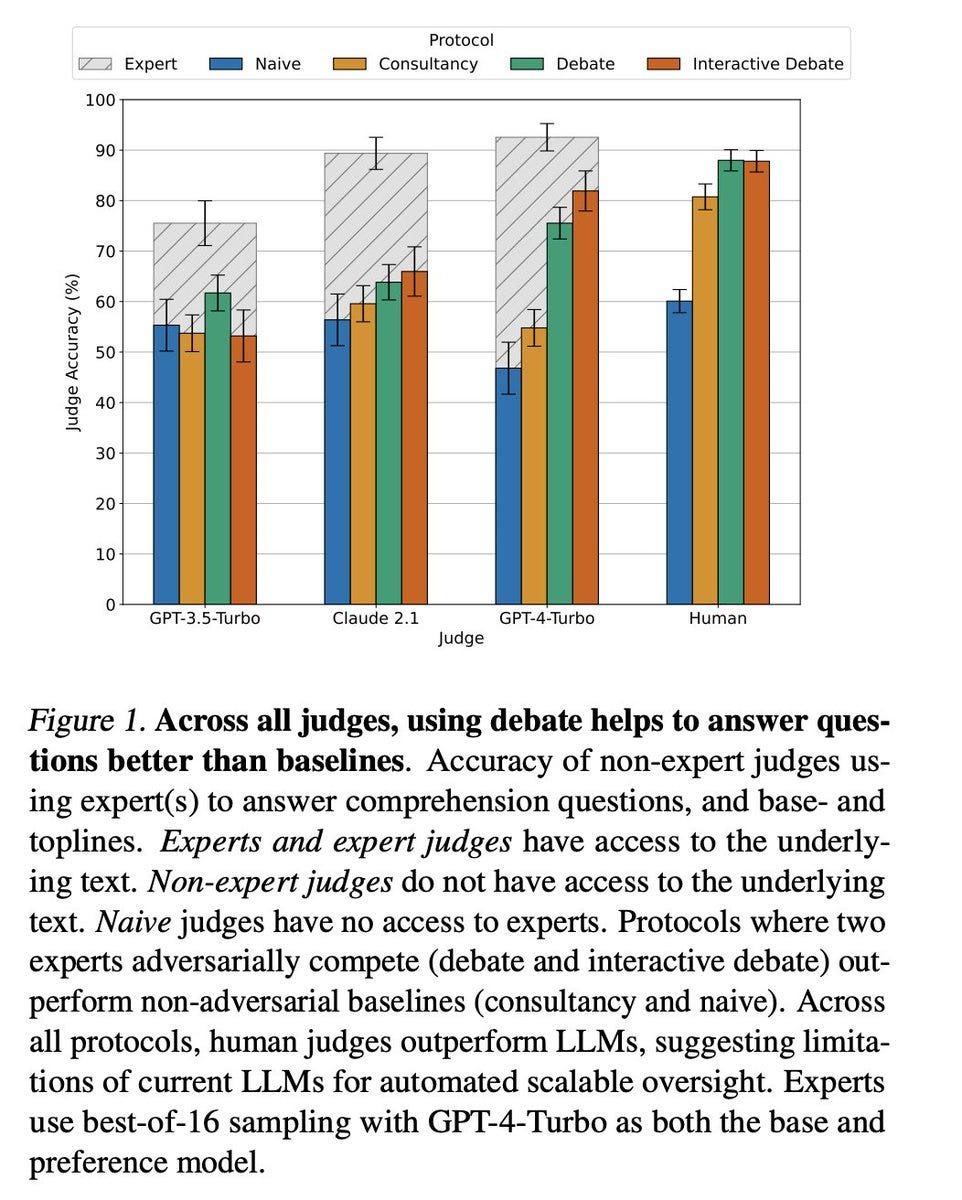
We operationalise experts and non-experts using the setup from Julian Michael, David Rein, where strong models have access to a comprehension text (experts) and weak models have to judge the answer without the text (non-experts).
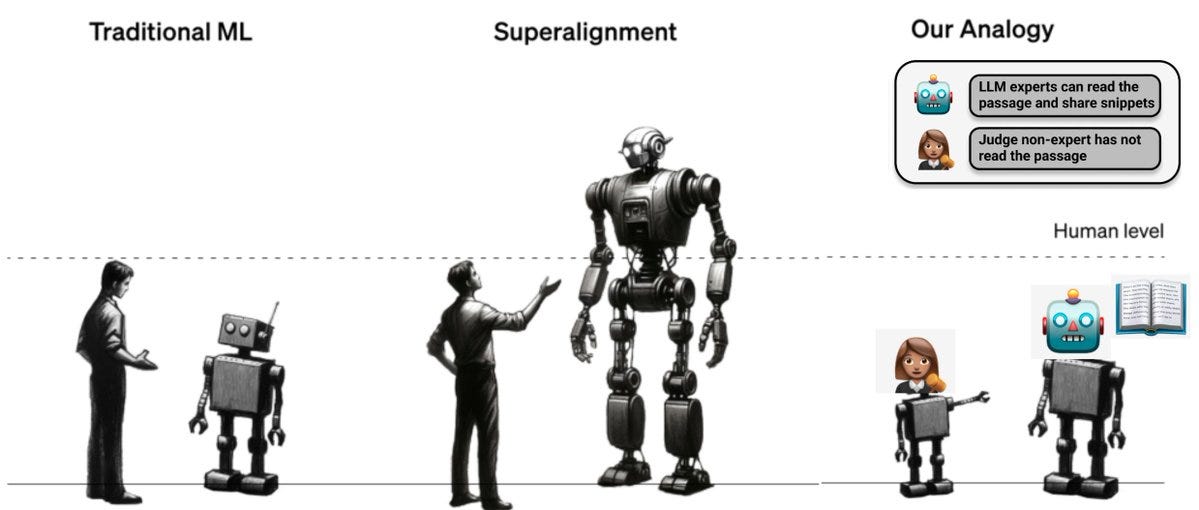
We consider debate, where we get two expert models to argue for different answers. Debates are three rounds, where each LLM produces arguments for why their answer is correct, quotes from the text as evidence, and critiques of their opponent’s arguments.
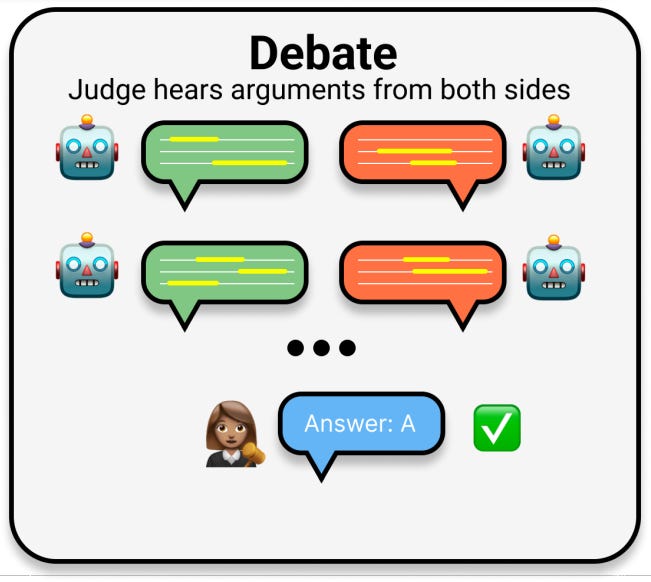
We also explore a “consultancy” baseline, where a single expert advocates for their pre-assigned answer. The hope is the non-expert can identify the right answer despite the information being one-sided.
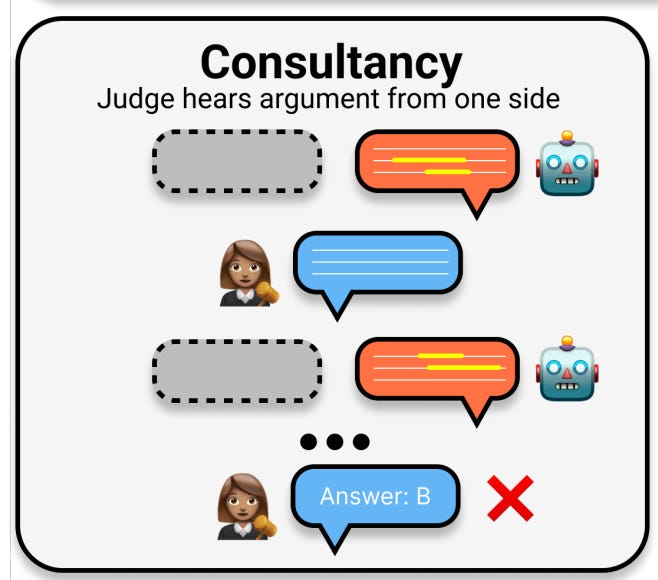
We find that judges (both LLMs and humans) are more accurate using debate than using consultancy. We also find using debates nearly closes the gap with expert judges who do have access to the underlying text!
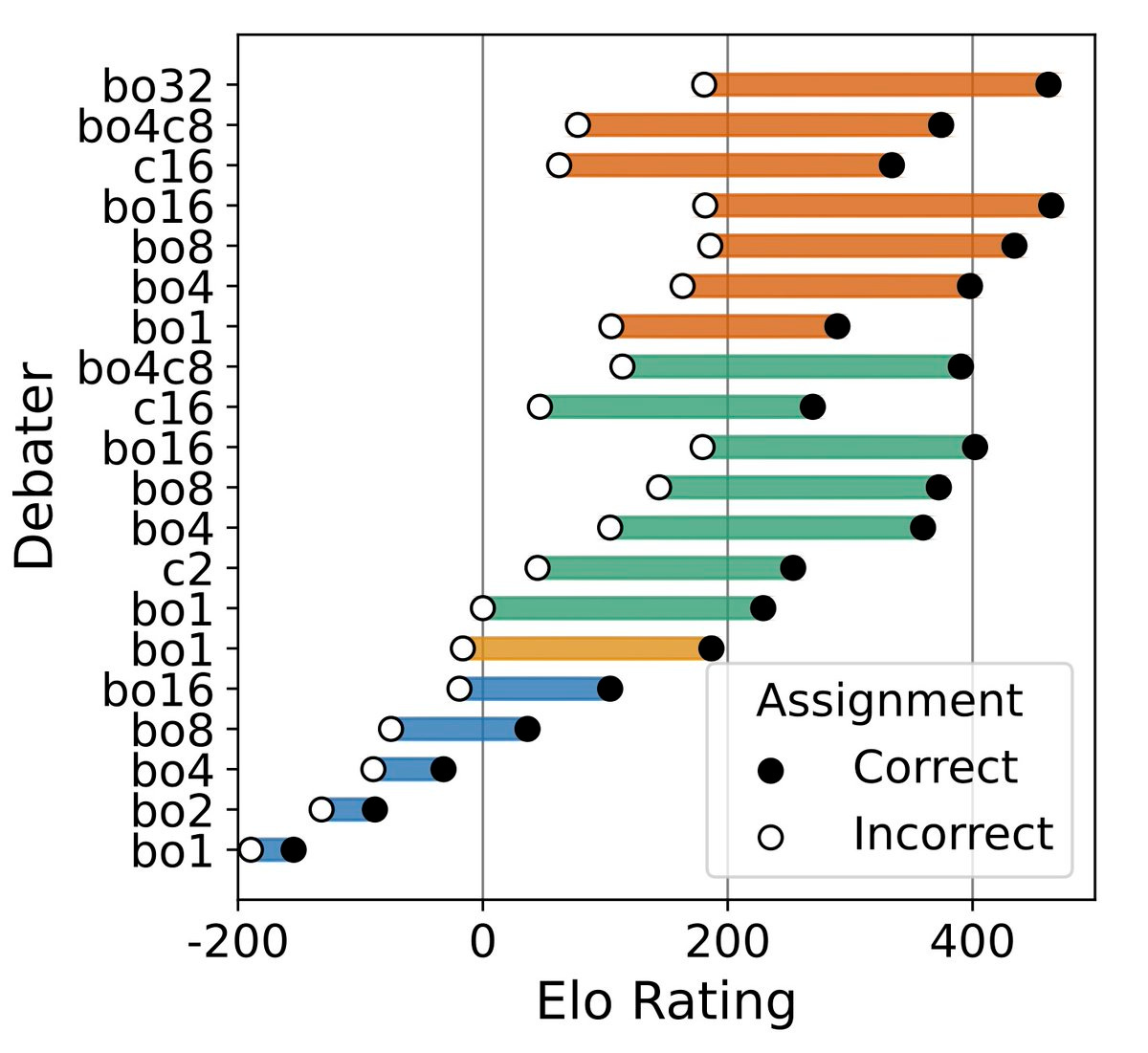
To evaluate whether debate works as models get smarter, we need a way to compare different experts - we measure persuasiveness, or how often a debater can convince a judge its answer is correct.
To compare different experts, we evaluate how often a judge choose its answers. We evaluate Elo ratings using matches between different debaters (cross-play) instead of copies of the same model (self-play).
We generate tonnes of debaters of varying levels of persuasiveness. The most persuasive debaters are comparatively better at arguing the correct answer relative to incorrect answers.
This suggests arguing for the truth is easier in our domain.
Taking debater Elo ratings (from cross-play), we then run self-play debates and show that more persuasive debaters lead to higher judge accuracy!
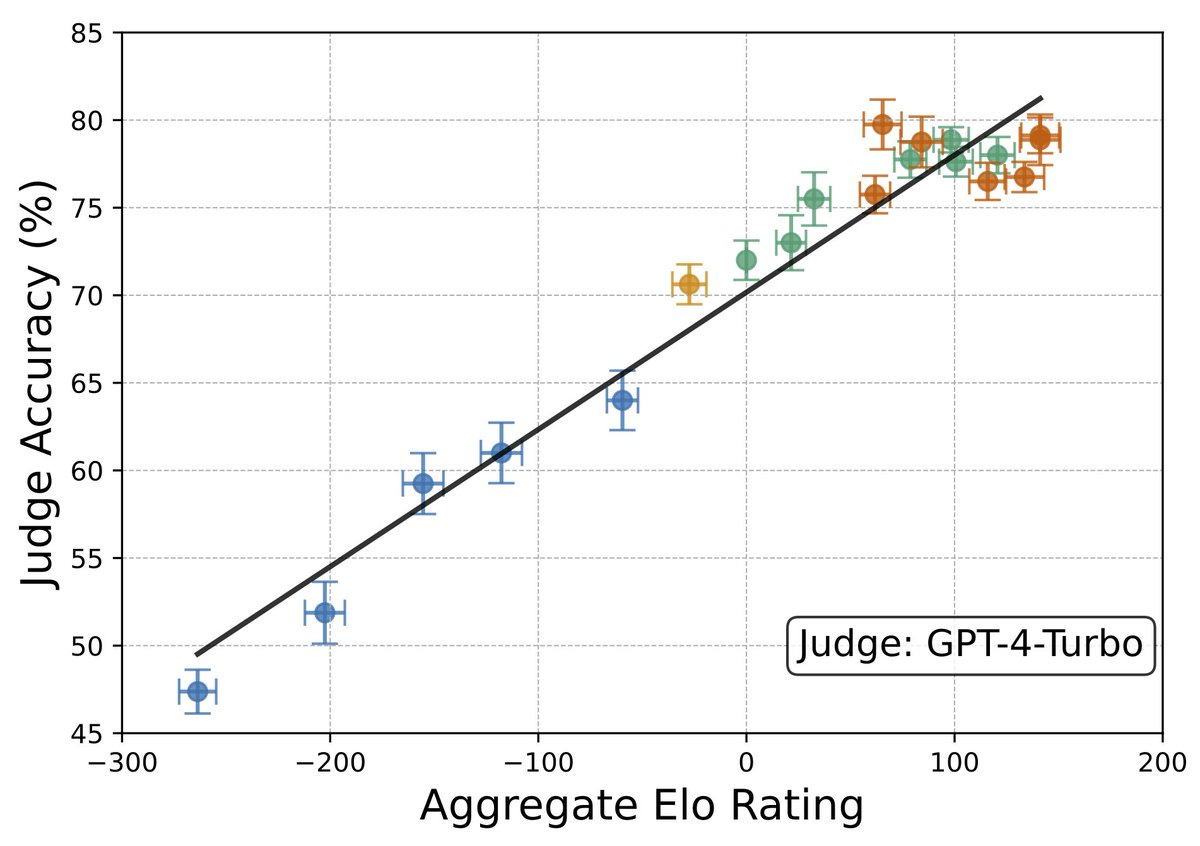
We use best-of-N optimisation for debaters against a GPT-4 judge. This optimisation improves both judge accuracy and Elo ratings on a variety of judge models. We conducted a large-scale human study with ParetoAI with humans judging over 1000 hours of debates. Our results hold when using human judges!
Read the full paper, code
Open Source Sparse Autoencoders for all Residual Stream Layers of GPT2-Small
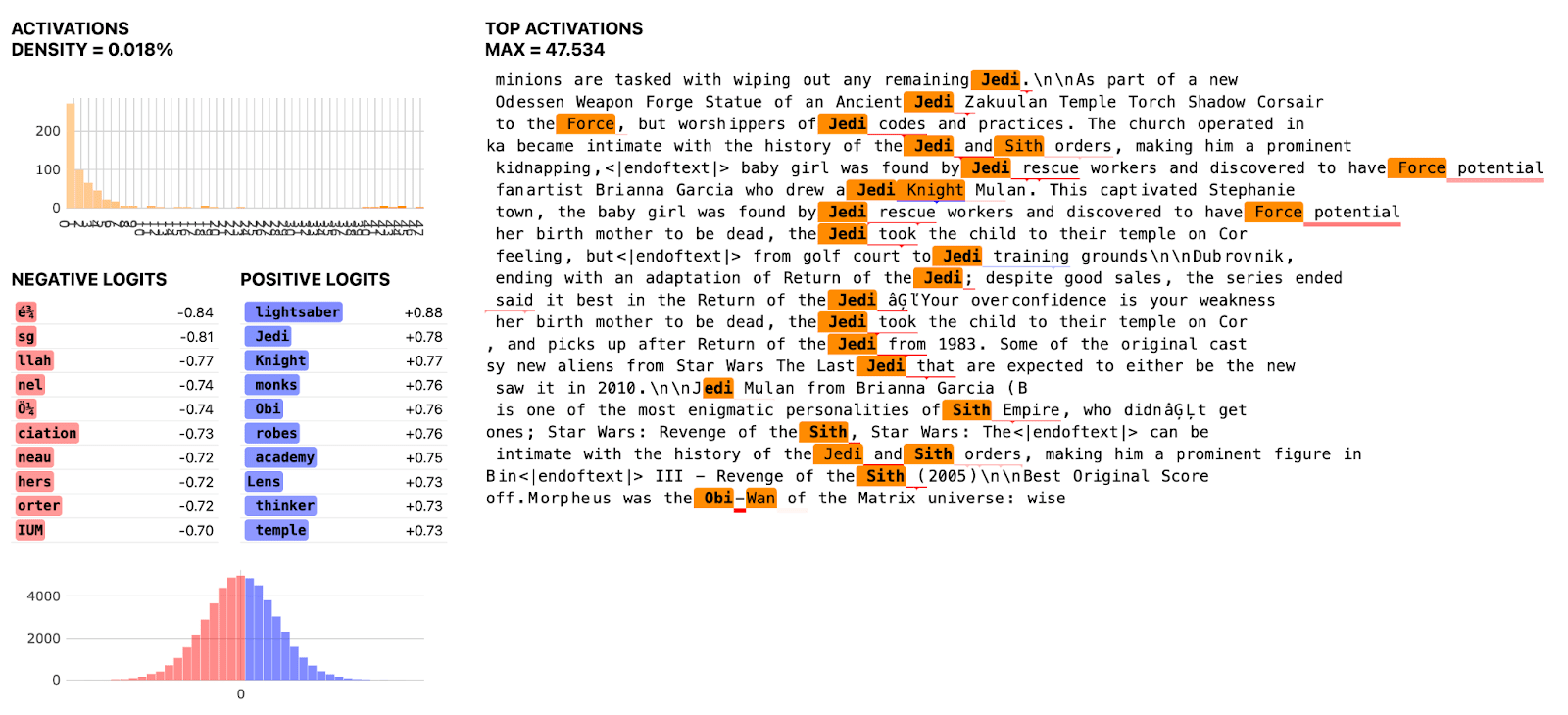
Summary: This is intended to be a fairly informal post sharing a set of Sparse Autoencoders trained on the residual stream of GPT2-small which achieve fairly good reconstruction performance and contain fairly sparse / interpretable features. More importantly, advice from Anthropic and community members has enabled us to train these fairly more efficiently / faster than before. The specific methods that were most useful were: ghost gradients, learning rate warmup, and initializing the decoder bias with the geometric median. We discuss each of these in more detail below.
Summary (GPT4): The authors achieved significant improvements in training efficiency and feature interpretability, utilizing techniques such as ghost gradients, learning rate warmup, and initializing decoder bias at the geometric median. These methods have enabled the training of SAEs with about 25,000 features each, displaying sparse and interpretable features with high-quality reconstruction performance.
The SAEs show a varying number of active features across layers, indicating changes in feature distribution with layer depth. Despite the lack of extensive analysis, the researchers have made training curves, feature dashboards, and Sparse Autoencoder weights available for public access. The improvement in training speed—from 20 hours to just 3 hours for certain models—highlights the effectiveness of the adopted techniques.
Sparse Autoencoders, by breaking down a model's activations into interpretable vectors, offer a potential pathway for understanding model internals and addressing AI alignment challenges. This work not only advances the field by training SAEs more efficiently but also opens up new avenues for research into model interpretability and misalignment through the lens of model internals. The authors encourage further exploration and experimentation with SAEs, providing resources and suggesting potential projects for interested researchers.
Read the full article
Red teaming an emotional companion chatbot: a case study of Suno Chat
Summary: Sometimes you need someone to talk to. To vent to. To pour your heart out to. Maybe some of us have asked ChatGPT questions at 3:00AM. What if there was a chatbot that you could talk to, one that’s empathetic, one that doesn’t give you the same boilerplate advice every 15 minutes. Enter Suno.chat. Suno is an AI-powered emotional companion developed to proactively and holistically support your wellness.
Issue
Chatbots come in many shapes and sizes. Some might help you easily return a product you bought online. Others might provide tech support. One thing to note is that different chatbots carry different risks. It isn’t necessarily about the sector they’re in either. A chatbot that helps you book an appointment carries a very different risk profile to a chatbot that provides you with a preliminary diagnosis.
Results
What we noticed was that much of the harm that could come from using an emotional companion chatbot could be broadly classified into two risk areas: derailment and a lack of helpfulness. With derailment, we tested for behavior that encouraged self-harm, lacked empathy, and used foul language. In terms of gauging helpfulness, we looked at how often our automated red teaming agent would send Suno into a loop of the same responses, whether it retained memory of early parts of the conversation, and how it resolved each conversation.